2026-08-24
Grinding Vise vs. Magnetic Chuck: Which Workholding Solution Is Right for Your Application?
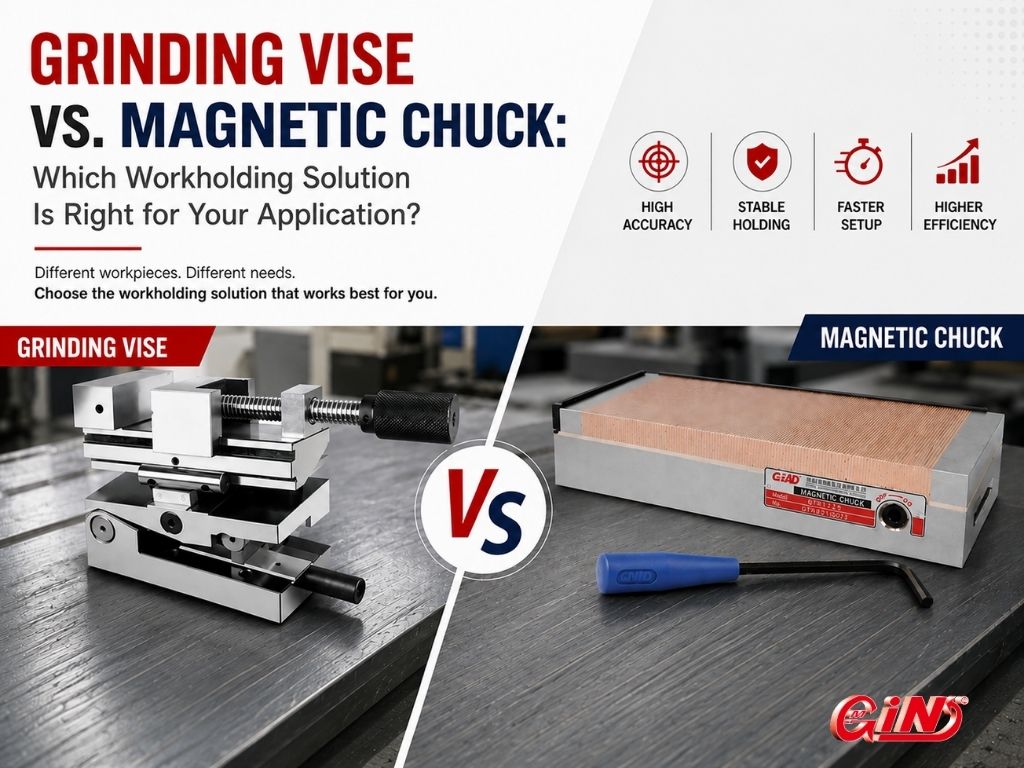
Achieving consistent accuracy in surface grinding depends on more than the grinding machine and grinding wheel. The way a workpiece is held can directly affect setup efficiency, accessibility, dimensional stability, and the quality of the finished surface.
Two common workholding solutions for precision grinding are the grinding vise and magnetic chuck. While both can provide stable workholding, they operate in fundamentally different ways and are suited to different workpiece materials, shapes, sizes, and machining requirements.
A grinding vise mechanically clamps the workpiece between jaws, making it useful when positive mechanical holding or precise positioning is required. A magnetic chuck uses magnetic force to hold ferrous workpieces across a contact surface, allowing an open setup with fewer physical obstructions.
So which one should you use? This guide compares grinding vises vs. magnetic chucks and explains the key factors to consider before choosing a workholding solution for your grinding application.
Table of Contents
- What Is a Grinding Vise?
- What Is a Magnetic Chuck?
- Grinding Vise vs. Magnetic Chuck: Key Differences
- When Is a Grinding Vise the Better Choice?
- When Is a Magnetic Chuck the Better Choice?
- How Workpiece Material, Size, and Shape Affect Your Choice
- Can a Grinding Vise and Magnetic Chuck Be Used Together?
- Gin Tech Grinding Vise and Magnetic Chuck Solutions
- FAQ: Grinding Vise vs. Magnetic Chuck
- Related Articles
- Conclusion: Which Workholding Solution Should You Choose?
What Is a Grinding Vise?
A grinding vise is a precision mechanical workholding device used to securely position a workpiece during grinding. Unlike general-purpose bench or milling vises, grinding vises are designed with an emphasis on geometric accuracy, including parallelism, squareness, and precisely ground reference surfaces.
A grinding vise holds the workpiece mechanically between its jaws. This provides positive clamping that does not depend on the magnetic properties of the workpiece.
Grinding vises are therefore useful for:
- Small precision components
- Workpieces requiring accurate jaw referencing
- Components that need controlled mechanical clamping
- Workpieces that cannot be held effectively by magnetic force
- Grinding, EDM, inspection, and other precision operations
A tool maker vise can also serve as a grinding vise when its construction, accuracy, and clamping characteristics meet the requirements of the grinding application.
The key advantage is control: the operator can position and clamp the workpiece against known reference surfaces, making the vise suitable for jobs where precise mechanical location is important.
What Is a Magnetic Chuck?
A magnetic chuck uses magnetic force to secure ferrous workpieces during machining. Instead of gripping the sides of the component with mechanical jaws, magnetic attraction holds the workpiece against the chuck surface.
This creates a relatively open working area and can reduce the need for clamps surrounding the workpiece.
Magnetic chucks are commonly used for:
- Surface grinding
- Grinding flat ferrous components
- Holding multiple suitable workpieces
- Applications requiring unobstructed access to the upper surface
- Thin or small ferrous parts when an appropriate pole configuration is selected
Gin Tech's magnetic chuck range includes permanent, fine-pitch, micropitch, rotary, and other configurations for different workpiece and machining requirements. Some models are specifically intended for surface grinding and EDM, while fine-pole designs are available for smaller and thinner workpieces.
Grinding Vise vs. Magnetic Chuck: Key Differences
Although both solutions can be used for precision grinding, the most important difference is how the workpiece is held.
| Comparison | Grinding Vise | Magnetic Chuck |
|---|---|---|
| Holding Method | Mechanical jaw clamping | Magnetic attraction |
| Workpiece Material | Can accommodate a wider range of materials depending on setup | Primarily suitable for ferromagnetic materials |
| Workpiece Access | Jaws may restrict access to some surfaces | Upper surface generally remains highly accessible |
| Positioning | Positive mechanical referencing | Position depends on chuck surface and setup |
| Irregular Parts | Often easier to mechanically locate and secure | Depends on contact area and magnetic circuit |
| Flat Ferrous Parts | Suitable depending on geometry | Particularly well suited |
| Thin Workpieces | Clamping force must be carefully controlled | Fine-pitch magnetic chucks may be advantageous |
| Setup Style | Individual mechanical clamping | Fast placement and magnetic holding |
| Typical Applications | Precision grinding, EDM, inspection | Surface grinding, EDM, selected machining operations |
Neither system is inherently better. The correct choice depends on the workpiece and the machining objective.
When Is a Grinding Vise the Better Choice?
A grinding vise is particularly useful when the application requires positive mechanical clamping or when magnetic workholding is unsuitable.
1. The Workpiece Is Not Suitable for Magnetic Holding
A magnetic chuck depends on the magnetic properties of the material. If the workpiece cannot generate sufficient magnetic holding force, mechanical clamping becomes necessary.
A grinding vise does not rely on magnetic attraction, making it a more flexible option across different workpiece materials.
2. Precise Mechanical Referencing Is Required
For some grinding operations, the workpiece must be accurately located against a jaw or reference surface.
A precision grinding vise provides clearly defined mechanical reference points, helping operators establish consistent workpiece positioning between setups.
3. The Workpiece Has Limited Magnetic Contact Area
Magnetic holding performance depends partly on the available contact area between the workpiece and chuck.
Components with irregular geometry, limited flat surfaces, or small magnetic contact areas may be more reliably held with a vise or another mechanical fixture.
4. The Same Workholding Device Is Used Across Different Processes
High-precision tool maker vises can be useful beyond grinding. Depending on the specific model and application, they may also be used for EDM, inspection, and other precision work.
For tool rooms handling varied low-volume work, this versatility can be especially valuable.
When Is a Magnetic Chuck the Better Choice?
A magnetic chuck becomes particularly attractive when the workpiece is ferromagnetic, has sufficient contact area, and benefits from unobstructed machining access.
1. Grinding Flat Ferrous Workpieces
Surface grinding often requires machining a large flat area. Mechanical clamps or vise jaws can interfere with wheel access.
A magnetic chuck holds the component from underneath, leaving the upper surface accessible for grinding.
2. Faster Loading and Unloading Is Important
For appropriate parts, magnetic workholding can simplify setup because the operator does not need to individually tighten vise jaws or external clamps.
This can be beneficial when processing repeated parts or multiple components.
3. Small or Thin Ferrous Parts Need Appropriate Support
Pole configuration matters when selecting a magnetic chuck.
Gin Tech's Powerful Micropitch Permanent Magnetic Chuck (0.4+1), for example, uses a fine-pitched magnetic pole design intended for small and thin workpieces and high-precision applications.
For larger and thicker workpieces, different pole configurations may be more appropriate. Gin Tech's Normal Pitch Permanent Magnetic Chuck, for example, is designed for large and thick workpieces.
This illustrates why choosing a magnetic chuck should involve more than simply deciding whether the workpiece is magnetic—the size, thickness, contact area, and pole pitch also matter.
How Workpiece Material, Size, and Shape Affect Your Choice
The decision between a grinding vise and magnetic chuck should begin with the workpiece itself.
Material
If the material is not suitable for magnetic workholding, a grinding vise or another mechanical fixture is generally required.
For ferromagnetic workpieces, both options may be possible.
Size and Thickness
A large flat workpiece may be particularly suitable for magnetic holding because it provides a broad contact area.
Smaller components may require a fine-pitch or micropitch magnetic chuck, while some small or irregular components may be easier to position in a precision vise.
Shape
Flat components generally provide favorable conditions for magnetic workholding.
Irregular workpieces, components with limited contact surfaces, or parts requiring specific orientation may benefit from the positive location provided by a grinding vise.
Required Machining Access
Consider where the grinding wheel needs to reach.
If the entire upper surface must remain accessible, magnetic workholding can reduce physical interference. If side access is less important and accurate mechanical positioning is the priority, a vise may be more suitable.
Can a Grinding Vise and Magnetic Chuck Be Used Together?
Yes. In fact, the decision does not always have to be grinding vise or magnetic chuck.
In some precision grinding setups, a tool maker vise can be positioned on a magnetic chuck. The magnetic chuck holds the vise, while the vise mechanically holds and locates the workpiece.
This combination can be useful when the workpiece itself is difficult to hold magnetically but the operator still wants the setup flexibility provided by a magnetic grinding table.
However, the complete setup must be evaluated carefully. Contact surfaces should be clean, flat, and suitable for secure holding, and the operator should verify that the resulting holding force and setup rigidity are sufficient for the grinding operation.
The correct configuration should always be determined according to the workpiece, grinding conditions, and equipment being used.
Gin Tech Grinding Vise and Magnetic Chuck Solutions
Gin Tech provides both precision tool maker vises within its grinding accessories range and a broad selection of magnetic chucks, allowing manufacturers to select workholding according to their actual machining requirements.
For applications requiring precise mechanical positioning, a Gin Tech tool maker vise can provide stable workholding for precision grinding and related operations.
For magnetic workholding, Gin Tech offers multiple chuck configurations for different workpiece conditions. Its Permanent Magnetic Chuck, for example, is designed for applications including grinding, milling, EDM, wire cutting, and measuring.
The magnetic chuck range also includes specialized configurations such as:
- Fine-pitch and micropitch magnetic chucks
- Magnetic chucks for small and thin workpieces
- Models for larger and thicker workpieces
- Rotary magnetic chucks for angular or rotary grinding
- Electro-permanent magnetic workholding solutions
Rather than treating one workholding method as universally superior, manufacturers should select the solution according to material, geometry, contact area, required accessibility, positioning requirements, and production workflow.
FAQ: Grinding Vise vs. Magnetic Chuck
Q1: Is a magnetic chuck better than a grinding vise for surface grinding?
Not necessarily. A magnetic chuck is particularly effective for suitable ferrous workpieces that benefit from open access to the grinding surface. A grinding vise may be more appropriate when mechanical positioning, non-magnetic materials, or irregular workpiece geometry are involved.
Q2: Can a grinding vise be placed on a magnetic chuck?
Yes, this is possible in suitable grinding setups. The magnetic chuck can hold the precision vise while the vise clamps the workpiece. However, the contact surfaces, magnetic holding force, and overall setup rigidity should be verified before machining.
Q3: Can magnetic chucks hold thin workpieces?
Yes, but the magnetic chuck should be selected according to the workpiece. Fine-pitch or micropitch pole configurations can be better suited to small and thin ferrous parts because the pole arrangement helps distribute magnetic holding across the workpiece. Gin Tech offers micropitch models specifically intended for small and thin workpieces.
Related Articles
- Magnetic Chuck vs Vise: Which Workholding Method Is Better for Your Setup? – Learn the broader differences between magnetic and mechanical workholding for machining and grinding applications.
- Why Tool Maker Vises Are Widely Used as Grinding Vises – Understand why precision tool maker vises are frequently selected for surface grinding, EDM, and inspection work.
- Choosing the Right Tool Maker Vise for Grinding, EDM, and Measurement Tasks – Explore the key factors that affect vise selection for high-precision grinding, EDM, and measurement applications.
Conclusion: Which Workholding Solution Should You Choose?
The choice between a grinding vise and magnetic chuck ultimately depends on the workpiece and grinding process.
Choose a grinding vise when you need positive mechanical clamping, precise jaw referencing, flexibility for different materials, or secure positioning of workpieces that are difficult to hold magnetically.
Choose a magnetic chuck when you are grinding suitable ferromagnetic workpieces and need broad surface access, efficient loading and unloading, or a low-interference workholding method.
For some applications, combining a precision vise with a magnetic chuck can provide the advantages of both systems.
Gin Tech offers both precision grinding accessories and magnetic workholding solutions for different machining requirements. If you are unsure which workholding method is best suited to your workpiece, contact Gin Tech to discuss your material, workpiece dimensions, grinding process, and accuracy requirements.
Our team can help you identify a suitable grinding vise, magnetic chuck, or workholding configuration for your precision grinding application.