2026-03-16
Why Self-Centering Vises Are Ideal for 5-Axis CNC Machining Centers
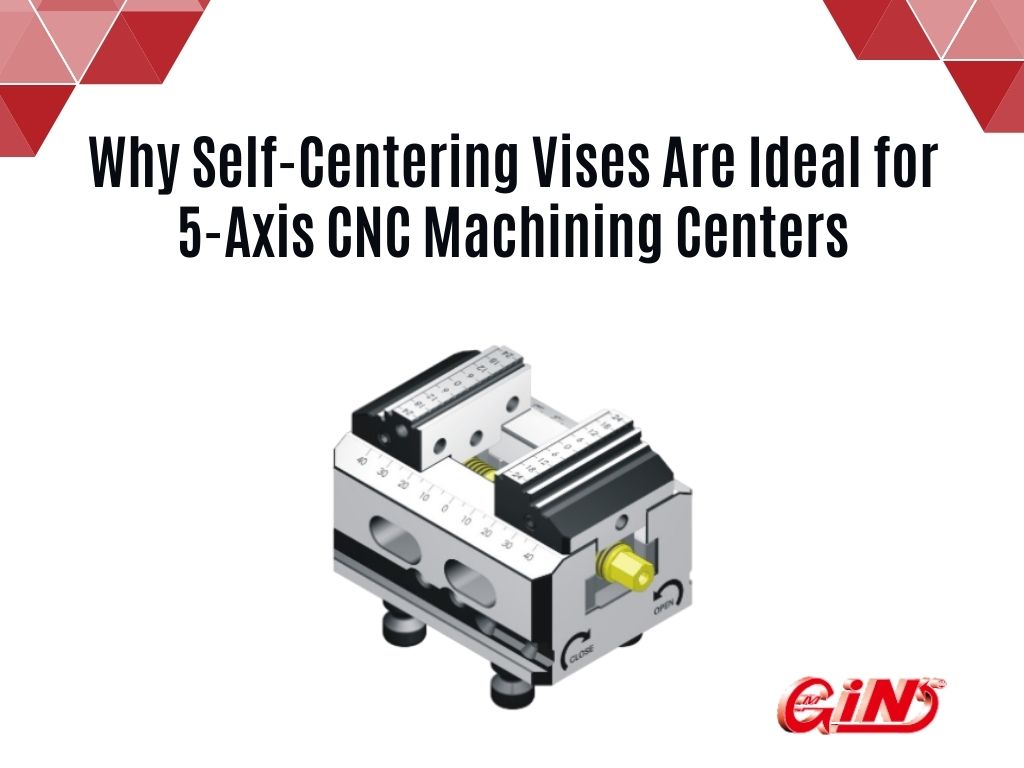
As manufacturing continues to evolve toward higher precision and greater efficiency, 5-axis CNC machining centers have become essential tools in many modern machining facilities. These machines allow complex parts to be machined in fewer setups, improving productivity and reducing cumulative machining errors.
However, the full advantages of 5-axis machining can only be achieved when the workholding system is designed to support multi-angle machining. Among the many workholding options available today, the self-centering vise has emerged as one of the most effective solutions for 5-axis CNC machining.
With its symmetrical clamping design, compact structure, and high positioning repeatability, a self-centering vise helps manufacturers maintain stability, accessibility, and precision during complex machining operations.
Understanding the Design of a Self-Centering Vise
A self-centering vise uses a synchronized jaw mechanism that moves both jaws simultaneously toward the center of the vise. When the vise is tightened, the workpiece is automatically positioned at the center without requiring manual alignment.
Compared with traditional single-moving-jaw vises, this design provides several important benefits:
-
Automatic workpiece centering
-
Balanced clamping force from both sides
-
Reduced setup time and operator adjustment
-
Consistent positioning for repeated machining cycles
These advantages make the self-centering vise particularly suitable for high-precision machining environments, especially when accurate centering and repeatability are required.
Why 5-Axis Machining Requires Specialized Workholding
Unlike traditional machining setups, 5-axis machining centers allow the workpiece to rotate and tilt during the machining process. This enables complex geometries to be produced in a single setup, but it also creates additional challenges for workholding.
A suitable workholding system for 5-axis machining must provide:
-
Stable clamping during multi-directional cutting
-
Compact design to avoid tool interference
-
High repeatability for accurate positioning
-
Strong yet balanced clamping force
If the vise is too bulky or poorly designed, it may block tool paths or limit machining angles. As a result, selecting the right workholding solution becomes critical for maximizing the capabilities of a 5-axis CNC machine.
Advantage 1: Automatic Workpiece Centering
One of the most valuable features of a self-centering vise is its automatic centering capability.
In traditional vises, the workpiece must be manually positioned against a fixed jaw, which can introduce alignment variation between setups. Even small positioning differences may lead to dimensional inconsistencies during machining.
With a self-centering vise:
-
Both jaws move simultaneously
-
The workpiece is automatically centered
-
Each clamping cycle produces consistent positioning
This ensures reliable alignment, which is particularly important for precision components that require accurate center-based machining.
Advantage 2: Balanced Clamping for Dimensional Stability
During 5-axis machining, cutting forces may change direction frequently as the workpiece rotates or tilts. A self-centering vise applies balanced clamping force from both sides, helping to maintain workpiece stability throughout the machining process.
Balanced clamping offers several benefits:
-
Reduced risk of workpiece distortion
-
Improved dimensional accuracy
-
More stable machining conditions
This is especially important for precision parts, symmetrical components, and thin workpieces that are sensitive to uneven clamping forces.
Advantage 3: Compact Design for Maximum Tool Accessibility
One of the key requirements in 5-axis machining is maintaining clear tool access from multiple angles.
Self-centering vises often feature:
-
Compact body design
-
Lower profile structure
-
Symmetrical jaw layout
These design characteristics minimize interference between the vise and cutting tools. As a result, machinists can approach the workpiece from different angles without repositioning it.
This improved accessibility allows more machining operations to be completed in a single setup, which reduces setup time and increases machining efficiency.
Advantage 4: Higher Setup Efficiency in Precision Machining
In modern CNC production environments, reducing setup time is essential for improving productivity.
Self-centering vises streamline the setup process because:
-
The workpiece is automatically centered
-
Jaw movement is synchronized
-
Positioning remains consistent between cycles
This reduces the time required for manual alignment and inspection, making self-centering vises ideal for precision machining and batch production environments.
Advantage 5: Compatibility with Automation and Zero-Point Systems
Automation is becoming increasingly common in CNC machining, particularly in facilities that operate robot loading systems or lights-out production lines.
Self-centering vises are well suited for automated machining because they provide:
-
Repeatable positioning
-
Consistent clamping behavior
-
Predictable workpiece placement
Many modern vises also support zero-point clamping systems, which allow quick installation and removal of workholding fixtures while maintaining high positioning accuracy.
Gin Tech PQV Self-Centering Vises for 5-Axis Machining
At Gin Tech, we design precision workholding solutions specifically for advanced CNC machining environments. Our PQV series self-centering vises are engineered for 5-axis machining centers, where compact structure, accurate centering, and stable clamping are critical.
The PQV series offers several important features:
-
High-precision machining design for exceptional accuracy and repeatable positioning
-
Quick jaw adjustment mechanism that reduces setup and changeover time
-
Strong and balanced clamping force to prevent slippage and minimize workpiece deformation
-
Automation-ready structure compatible with robotic loading and unmanned production
-
Zero-point system compatibility, supporting 96/52 grid patterns as well as EROWA and System 3R quick-change systems
With these capabilities, the PQV series provides a reliable workholding solution for manufacturers seeking to maximize the performance of their 5-axis CNC machining centers.
FAQ: Self-Centering Vises in 5-Axis CNC Machining
Q1: Why are self-centering vises ideal for 5-axis machining?
Because they provide symmetrical clamping, compact design, and high repeatability, which improve tool accessibility and machining accuracy.
Q2: Can a self-centering vise improve machining precision?
Yes. Automatic centering and balanced clamping help maintain consistent positioning and reduce dimensional variation.
Q3: Are self-centering vises suitable for automated machining systems?
Yes. Their repeatable clamping behavior makes them compatible with robotic loading and automated production environments.
Q4: What types of parts benefit most from self-centering vises?
Precision components, symmetrical parts, and parts requiring accurate center alignment benefit the most from this type of vise.
Conclusion
As manufacturers continue to adopt 5-axis CNC machining centers, selecting the right workholding system becomes increasingly important. A self-centering vise offers clear advantages in terms of workpiece centering, balanced clamping, setup efficiency, and automation compatibility.
For complex multi-angle machining operations, a well-designed self-centering vise helps ensure stable clamping and reliable positioning throughout the machining process.
At Gin Tech, we specialize in precision workholding solutions designed for modern CNC machining environments. Our PQV self-centering vises help manufacturers achieve stable, accurate, and efficient machining performance in demanding 5-axis machining applications.